
How Much Does It Cost
to Build a Childcare Center?
Everything you need to know about childcare construction costs from land acquisition and financing to architecture, construction, and opening day.
Building a childcare center is a big dream.
It’s also a major financial commitment, and it’s completely reasonable to want a clear answer before you take the next step.
If you’ve searched “How much does it cost to build a childcare center?” and hoped to find one simple number, you’ve probably discovered why the answer is frustrating: it depends on the project. Two centers with a similar number of classrooms can have very different budgets because the properties, site conditions, local requirements, construction scope, and financing are different.
There isn’t one reliable price that applies to every childcare center.
The total depends on what you’re starting with, what the property can support, what your local jurisdiction requires, and what it will take to open the center you have in mind.
The goal isn’t to guess at a number and hope everything works out. It’s to understand what goes into the total cost, figure out which details could change your budget, and investigate the big risks before you commit to a property or design.
That matters because some of the most expensive surprises start with a decision that seemed small at the time:
-
-
- a site that needs major improvements,
- a building that can’t support the planned enrollment,
- or a design that has to be revised after a requirement comes to light.
-
A little homework early can help you make a much more confident decision about what to do next.
On this page, we’ll walk through the major costs involved in developing a childcare center, from the property and site work to design, construction, equipment, and financing. You’ll have a clearer picture of what belongs in your budget and what to ask before spending money.
When you’re building a budget, look beyond the building itself.
A project may include:
- Land or the cost of leasing or purchasing an existing property
- Site investigation and site development
- Architecture and engineering
- Permits and government fees
- Utility connections and upgrades
- Building construction or renovation
- Furniture, fixtures, and equipment
- Playground and outdoor areas
- Technology and security systems
- Financing costs, including interest during construction
- A contingency for unknowns and changes
Some of these costs are easy to see early. Others depend on what you learn during due diligence, design, permitting, and construction. That’s why a property’s asking price – or a contractor’s early estimate – is only one piece of the financial picture.
How Much Should You Budget for Land?
The first number you see is usually the price of the property. It’s an important number, but it doesn’t tell you what the site will ultimately cost to use for a childcare center.
Before you fall in love with a parcel or sign a lease, ask a more useful question: What would it take to make this property work for my center? The answer may depend on zoning, utilities, access, parking, playground space, drainage, site conditions, the building’s layout, and the number of children the project could realistically serve.
A lower purchase price can be tempting. But if the property needs substantial site work, utility upgrades, or changes to meet applicable requirements, those costs can change the economics quickly. A more expensive site might be the better fit if it supports your plan with fewer costly obstacles. You won’t know which is true by comparing listing prices alone.
Should you buy land, lease a building, or renovate?
Each path has trade-offs.
Buying land gives you more freedom to plan a center around your program, operations, and enrollment goals. It can also mean taking on site development, permitting, utility, and construction costs before you open.
Leasing or buying an existing building may look like a faster or less expensive route. Sometimes it is. But an existing building wasn’t necessarily designed for childcare. The layout, accessibility, building systems, outdoor space, or site may need significant changes. Renovation costs can also be hard to pin down until the building has been investigated.
The right choice depends on the specific property and your business plan. Before committing, look at the complete project—not just the rent, purchase price, or initial renovation estimate.
Does location affect the budget?
Yes, and not only because land prices vary. Location can affect construction costs, utility access, permitting, traffic circulation, and the work needed to prepare a site. It also matters to the business you’re building.
Think about the families you want to serve. Is the site easy for them to reach? Is it visible and convenient for drop-off and pick-up? Are there young families in the area, nearby employers, and enough demand to support the center? What other childcare options are nearby, and what makes your center a good choice?
A site that looks like a bargain can become an expensive choice if it doesn’t support your development plan or the center’s long-term enrollment. On the other hand, paying more for a property doesn’t automatically make it the right one. The important thing is to evaluate cost, feasibility, and business potential together.
Before making an offer or signing a lease, confirm what you can about zoning, utilities, access, site conditions, and the property’s ability to support your intended use. If you’re unsure what to investigate, get experienced guidance before you’re committed. Finding a problem early gives you more options than finding it after you’ve spent money on design or construction.
Read our complete guide: How to Choose the Right Property for a Childcare Center
Before you commit to a property
- Compare the likely total development cost, not just the purchase price or rent.
- Weigh a ground-up project against leasing, buying, or renovating an existing building.
- Check zoning and confirm what due diligence is needed for your intended use.
- Investigate utilities, access, parking, playground space, and site conditions.
- Consider whether the location can support the families and enrollment your business needs.
- Ask what could make the project more expensive, delayed, or difficult to approve.
A property can look right on paper and still carry questions you haven’t thought to ask yet. You don’t have to know every answer before you start. You do want to find the important questions before you make a commitment that’s difficult or expensive to undo.
uilding a childcare center is one of the largest investments most owners will ever make.
One of the first questions every prospective childcare owner asks is, “How much does it cost to build a childcare center?” Unfortunately, there isn’t a one-size-fits-all answer. The total cost depends on dozens of factors, including location, building size, site conditions, construction methods, licensing requirements, and even seemingly small design decisions that can add—or save—hundreds of thousands of dollars.
This guide walks you through every major cost involved in developing a childcare center so you can build a realistic budget, avoid common mistakes, and make informed decisions before spending money.
Building Cost ≠ Project Cost
A 12,000 SF childcare center at $225/SF sounds like a $2.7 million project.
But once the owner accounts for the land, site development, design, permits, contractor costs, financing, playground, furniture, equipment, supplies and working capital, the actual investment can be millions of dollars higher.
2026 Ground-Up Childcare Center Development Budget, in approximate order of when the expenses occur for a building that is a one-story 12,000 SF ground-up childcare center.
| Cost Category | 2026 Low | 2026 High | |
|---|---|---|---|
| 1 | Franchise Fee | $40,000 | $80,000 |
| 2 | Predevelopment + Due Diligence | $5,000 | $25,000 |
| 3 | Land Acquisition | $500,000 | $1,500,000 |
| 4 | Architecture + Civil + Structural + MEP | $300,000 | $650,000 |
| 5 | Government + Permit + Impact Fees | $100,000 | $300,000 |
| 6 | Financing / Loan Costs | $250,000 | $600,000 |
| 7 | Site Construction | $750,000 | $1,500,000 |
| 8 | Building Construction | $2,700,000 | $4,550,000 |
| 9 | GC Overhead / Profit / General Conditions — 10–12% | $345,000 | $726,000 |
| 10 | Construction Contingency | $175,000 | $450,000 |
| 11 | Playground Fencing & Gates | $40,000 | $100,000 |
| 12 | Playground Safety Surfacing | $75,000 | $200,000 |
| 13 | Playground Equipment | $125,000 | $300,000 |
| 14 | Furniture & Classroom Equipment | $125,000 | $250,000 |
| 15 | Office / Administrative FF&E | $20,000 | $50,000 |
| 16 | Toys, Learning Materials & Art Supplies | $40,000 | $100,000 |
| 17 | Working Capital / Opening Reserve | $250,000 | $500,000 |
TOTAL PROJECT INVESTMENT |
$5,840,000 |
$11,281,000 |
These are planning ranges – not bids.
Land values, site conditions, utility availability, jurisdictional requirements, construction costs,
financing terms and franchise requirements can dramatically change the final project cost.
Important assumptions:
- Building construction: $225–$325/SF, producing approximately $2.7M–$4.55M for a 12,000 SF center.
- GC overhead/profit/general conditions: calculated at 10% – 12% of building + site construction.
- Playground total: $240,000–$600,000, including fencing, surfacing and equipment.
- Furniture, equipment, toys and supplies: $185,000–$400,000 combined.
1 – Franchise Fees: $40,000–$80,000+
One of the first decisions you’ll make is whether to open an independent childcare center or buy into an established franchise. The obvious way to eliminate franchise fees is to go independent; but the franchise fee isn’t necessarily wasted money. You’re paying for a business model that has already been developed, including branding, operating systems, training, marketing support, curriculum, purchasing relationships and, in many cases, guidance through the development and opening process. For a first-time childcare owner, that structure can shorten the learning curve and help you avoid having to create every system from scratch.
The trade-off is cost and control.
The initial franchise fee is only the beginning. Franchisees may also have ongoing royalty fees, marketing or advertising fees, technology fees, training expenses, required vendors and other recurring charges. Some royalties are calculated as a percentage of gross revenue, which means they continue for as long as you operate the business; not just until the building is paid for.
Before signing a franchise agreement, look beyond the initial franchise fee and calculate what the franchise could cost over 5, 10 or even 20 years.
Franchising can also affect your construction and development budget.
Most established brands have prototype plans, design standards, required finishes, signage packages, furniture specifications, playground standards and approved vendors. Standardization can save money when it simplifies decisions or gives you access to negotiated pricing, but it can also increase costs if you’re required to purchase a particular product or build to a standard that is more expensive than what you would have selected independently. You may also have less flexibility to value-engineer the project when construction costs start climbing.
Going independent eliminates franchise fees and gives you much more control over your building, branding, curriculum, vendors and operating model.
But independent doesn’t mean free.
You’ll need to develop many of the things the franchisor would otherwise provide: your name and brand, website, marketing strategy, curriculum, policies and procedures, enrollment systems, technology, employee training, signage and operating processes. Some of those costs replace part of what you would have paid to a franchisor, and they should be included in your startup budget.
The right question isn’t simply, “Which option costs less?” It’s “What am I getting for the money?”
A strong franchise system may be worth the additional expense if its brand recognition, operating systems, training and support help you open faster, attract families and operate more effectively. On the other hand, an experienced operator with a strong concept and established systems may decide that the ongoing franchise costs outweigh the benefits.
Money-Saving Tip: Before choosing a franchise, calculate the total cost of ownership, not just the initial franchise fee. Compare the upfront fee, ongoing royalties, marketing fees, required purchases and construction standards against what it would realistically cost you to develop and operate an independent childcare brand yourself.
Key Takeaways
- Budget $40,000–$80,000+ for the initial franchise fee.
- The franchise fee is only the beginning.
- Franchise requirements can affect construction costs.
- A franchise can save you time and reduce the learning curve.
- Going independent eliminates franchise fees, but it doesn’t eliminate startup costs. Y
- Compare the long-term cost, not just the startup cost.
- Ask what you’re getting for the money.
2 – Predevelopment + Due Diligence: $5,000–$25,000+
Predevelopment is the money you spend before committing hundreds of thousands—or millions—of dollars to a property and construction project.
It can include zoning research, site feasibility, preliminary architectural planning, surveys, environmental reports, utility investigations, preliminary civil engineering, demographic research and other studies needed to determine whether a property can actually support your childcare business.
This is one of the easiest areas for owners to want to save money because, at this stage, you’re spending money without getting anything tangible in return. There isn’t a building yet. There may not even be a property under your control.
It can feel difficult to spend $5,000, $10,000 or $20,000 investigating a property you might ultimately decide not to buy.
But sometimes walking away is exactly what you’re paying to discover.
A property can look perfect and still have serious problems hiding below the surface. The zoning may not allow childcare. The site may not have enough parking. The playground may not be large enough for your desired enrollment. Fire department access requirements could reduce your usable site area. Utilities may need expensive upgrades. Stormwater requirements, wetlands, easements, buffers, grading, retaining walls or poor soils can dramatically increase site-development costs. An existing building can introduce another set of problems, including change-of-use requirements, fire sprinklers, accessibility upgrades, insufficient exits or expensive mechanical and electrical improvements.
This is also when your business plan and building plan need to meet each other.
If your financial model requires 200 children, it’s not enough to know that a building can physically fit on the property. You need to determine whether the entire site can support the classrooms, parking, playground, circulation, fire access and other requirements necessary to achieve that enrollment. A property that only supports 150 children may still be a perfectly good childcare site but it may not support your business model.
Predevelopment costs can vary significantly depending on the property.
A relatively straightforward leased space may only require zoning verification, a test fit and preliminary code review. A ground-up development may require a survey, geotechnical investigation, environmental assessment, traffic analysis, civil engineering, utility research and meetings with local authorities before you’re comfortable moving forward. Spending more on due diligence is often appropriate when there is more money at risk.
There are ways to control these costs. Don’t order every study on Day One.
Start with the biggest potential deal breakers and investigate the project in stages. Confirm basic zoning, property size, childcare capacity and obvious site constraints before paying for more expensive engineering and specialty reports. If the first round uncovers a fatal flaw, stop. You may have spent several thousand dollars, but you avoided spending considerably more pursuing a property that was never going to work.
The goal of predevelopment isn’t to prove that you should move forward. It’s to give you enough information to make a good decision either way.
Sometimes the best outcome of due diligence is a green light. Sometimes it’s discovering a problem early enough to renegotiate the deal. And sometimes it’s having the confidence to walk away before a bad property becomes an expensive mistake.
Money-Saving Tip: Put a due-diligence period in your purchase or lease agreement whenever possible and investigate the biggest deal breakers first. Spending $5,000–$25,000 before committing to a property can feel expensive, but it may be some of the least expensive money you spend on the entire project.
Key Takeaways
Budget approximately $5,000–$25,000+ for predevelopment and due diligence.
Do your due diligence before you buy the property or sign an unconditional long-term lease.
Investigate the biggest deal breakers first.
Make sure the property supports your business model, not just a childcare use.
Don’t order every report at once.
Existing buildings require due diligence too.
Walking away isn’t wasted money.
The purpose of due diligence is to uncover what you don’t know before you commit to it.
3 – Land Acquisition $500,000 – $1,5000,000
How much should you budget for land?
The cost of land is often one of the largest variables in a childcare development project.
In some areas, land may represent only a small percentage of your total investment, while in high-demand markets it can become the single largest expense. Before purchasing a property, it’s important to evaluate more than just the asking price. Site improvements, utility availability, zoning restrictions, traffic access, environmental conditions, and local childcare demand can dramatically affect both your construction budget and your long-term profitability.
One of the first decisions you’ll face is whether to purchase land, lease an existing building, or renovate a commercial property.
Buying land gives you the flexibility to design the ideal childcare center from the ground up, but it also requires additional costs for site development, permitting, and utility installation. Leasing or purchasing an existing building may reduce your upfront investment and shorten your construction schedule, but not every building can be economically converted into a childcare center. Renovations often uncover hidden expenses such as inadequate utilities, structural modifications, accessibility upgrades, or playground limitations.
Location is equally important.
A highly visible site along a busy commuter route may cost more initially but can significantly reduce your marketing costs and increase enrollment over time. Demographics also play a major role in your long-term success. Population growth, household income, the number of young families, nearby employers, and competing childcare centers should all be evaluated before making a purchase.
A less expensive property in the wrong location can ultimately cost far more than paying a premium for a site with stronger demand.
→ Read our complete guide: How to Choose the Right Property for a Childcare Center
Key Takeaways
- Compare the total development cost—not just the purchase price.
- Evaluate buying land versus renovating an existing building.
- Research demographics and future population growth.
- Prioritize visibility, accessibility, and traffic patterns.
- Confirm zoning and utility availability before making an offer.
4 – Architecture + Civil + Structural + MEP: $300,000–$650,000
Design and engineering fees are often one of the first large professional expenses in a childcare development.
For a typical ground-up center, budget approximately $300,000–$650,000 for the full design team, which may include the architect, civil engineer, structural engineer, mechanical engineer, electrical engineer, plumbing engineer and other specialty consultants required for the project.
The architect typically coordinates the overall building design and brings the various disciplines together into one set of construction documents. The civil engineer handles the site: grading, drainage, stormwater, utilities, parking and other infrastructure. The structural engineer designs the building’s structural systems, while the MEP engineers design the heating and cooling, electrical, lighting, plumbing and related building systems. And because you are a childcare center, you will also need landscape architecture, fire protection, kitchen design, low-voltage/security design or other specialty consultants.
It can be tempting to shop for the lowest design fee, especially when you’re comparing proposals and one team is significantly less expensive than another. But professional fees should be evaluated against the much larger amount of money those professionals are helping you spend.
If you’re about to build a $5 million facility, saving $50,000 in design fees isn’t much of a savings if poor coordination, inefficient planning or missed requirements add $200,000 to construction or reduce the number of children your center can enroll.
For childcare centers in particular, design decisions directly affect the business model.
Classroom sizes, age-group distribution, plumbing fixtures, corridors, exits, kitchens, staff areas, parking and playground configuration all compete for limited space. An inefficient floor plan may require a larger building to achieve the same enrollment. Conversely, thoughtful planning may allow you to achieve your target capacity within a smaller footprint, potentially saving construction costs while also reducing long-term operating and maintenance expenses.
The same principle applies to the site. Civil engineering decisions can have enormous cost implications. Building placement affects grading, retaining walls, utility runs, stormwater systems, parking, fire access and playground space. Moving a building or playground on paper is relatively inexpensive. Moving it after construction begins is not. This is why the architect and civil engineer should be coordinating early rather than designing the building and site independently.
Your architect’s engineers also have opportunities to control costs.
Structural systems can be designed efficiently rather than overbuilt. Mechanical equipment can be properly sized rather than unnecessarily oversized. Electrical and plumbing systems can be coordinated with the architectural layout before construction.
Good design doesn’t necessarily mean choosing the cheapest system, it means selecting systems that satisfy the project’s requirements without paying for things the project doesn’t need.
Another important consideration is scope.
Two architectural or engineering proposals can have very different prices because they include very different services. One may include programming, schematic design, permit drawings, bidding assistance and construction administration, while another may include little more than a permit set. Before comparing fees, compare exactly what is included, what is excluded, how many design revisions are allowed and who will assist you when questions or problems arise during permitting and construction.
There are appropriate ways to save money on professional fees.
A well-developed prototype can reduce design time on multiple locations. Making major decisions early can reduce redesign. Providing accurate surveys and franchise requirements at the beginning can prevent teams from drawing the same project multiple times. Keeping the architect, civil engineer and other consultants coordinated also reduces conflicts that can become expensive change orders in the field.
What I would not recommend is saving money by eliminating necessary design or coordination.
Construction is where the large dollars are spent, but design is where you have the greatest ability to influence how those dollars will be spent. A line moved on a drawing costs almost nothing. That same change after concrete has been poured, walls have been framed or utilities have been installed can cost thousands.
Money-Saving Tip: Don’t ask only, “How much does the architect cost?” Ask, “How will this design team help me control the cost of the entire project?” The goal isn’t necessarily to hire the least expensive team. It’s to spend your design dollars where they can prevent larger construction and operational costs later.
Key Takeaways
Compare scope as well as price.
Your floor plan affects profitability.
Site design can have major cost consequences.
Don’t eliminate construction-phase services to save money.
The cheapest design fee doesn’t produce the cheapest project
5 – Government + Permit + Impact Fees: $100,000–$300,000
Government fees are one of the most difficult costs to predict because they vary dramatically by city, county and utility provider. For preliminary budgeting, I recommend allowing approximately $100,000–$300,000 for government-related fees associated with developing and opening a childcare center.
Most owners know they’ll need to pay for a building permit, but the building permit is only one piece of the cost.
You may also encounter zoning and development application fees, plan-review fees, land-disturbance permits, fire department reviews, mechanical, electrical and plumbing permits, signage permits and other local approvals.
One of the biggest costs owners sometimes overlook is utility connection and impact fees.
Even if water and sewer are already available at the property, you may have to pay tap fees, meter fees, sewer capacity charges or other connection fees before you can use them. Some communities also charge transportation, development or other impact fees based on the size and use of your project.
These fees can also occur at different stages of development.
Application and review fees may be required early, permit fees are generally paid closer to construction, and some utility or impact fees may not be due until later in the project. That makes it important to understand not only how much you’ll pay, but when you’ll need the money.
There aren’t many opportunities to value-engineer a government fee after you’ve selected your property. Your best opportunity to control this cost is during due diligence. Research the fee structure before committing to a site and include these expenses in your development budget from the beginning.
Money-Saving Tip: Don’t ask only, “How much is the building permit?” Ask about application fees, review fees, utility connection fees, impact fees and any other government charges required to get from property acquisition to an approved childcare center.
Key Takeaways
The building permit is only one part of the cost.
Don’t overlook utility connection fees.
Impact fees vary widely by jurisdiction.
Find out when the fees are due.
Research these costs during due diligence.
Construction Costs
Construction usually represents the largest expense.
Discuss:
* cost per square foot
* regional differences
* inflation
* building size
**Read More →**
**Childcare Construction Cost per Square Foot**
—
Furniture, Fixtures & Equipment (FF&E)
* classroom furniture
* cribs
* playground
* office furniture
* kitchen
—
Financing Costs
* loan fees
* interest during construction
* appraisals
* lender inspections
—
Hidden Costs
This section will become one of your biggest traffic generators.
Discuss:
* unsuitable property
* utility upgrades
* retaining walls
* stormwater
* bad soils
* zoning
* change orders
**Read More →**
**27 Costly Childcare Building Mistakes**
—
Construction Costs
Construction usually represents the largest expense.
Discuss:
* cost per square foot
* regional differences
* inflation
* building size
**Read More →**
**Childcare Construction Cost per Square Foot**
—
Permits & Government Fees
* building permit
* impact fees
* tap fees
* utility fees
* fire marshal
—
Furniture, Fixtures & Equipment (FF&E)
* classroom furniture
* cribs
* playground
* office furniture
* kitchen
—
Financing Costs
* loan fees
* interest during construction
* appraisals
* lender inspections
—
Hidden Costs
This section will become one of your biggest traffic generators.
Discuss:
* unsuitable property
* utility upgrades
* retaining walls
* stormwater
* bad soils
* zoning
* change orders
**Read More →**
**27 Costly Childcare Building Mistakes**
—
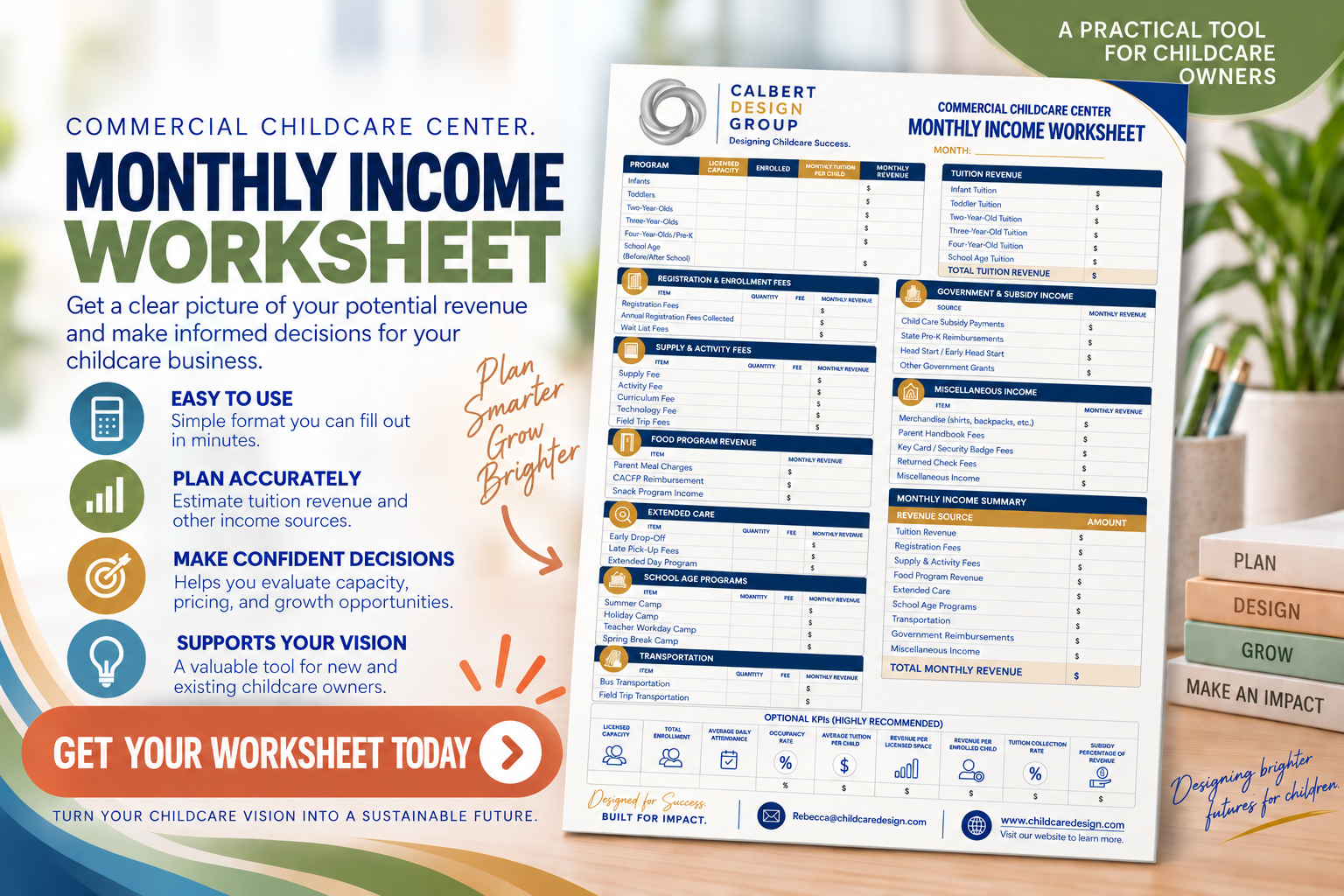
CAN YOUR CHILDCARE CENTER SUPPORT THE COST TO BUILD IT?
Before you finalize a construction budget, you need to understand what your childcare center can actually earn.
This free Monthly Income Worksheet helps you estimate tuition, enrollment, fees and other revenue so you can begin building a realistic business plan and construction pro forma.
Use it to test different enrollment and tuition scenarios, understand your potential monthly revenue, and make more informed decisions about how much you can afford to invest in your building.
CAN YOUR CHILDCARE CENTER SUPPORT THE COST TO BUILD IT?
Before you finalize a construction budget, you need to understand what your childcare center can actually earn.
This free Monthly Income Worksheet helps you estimate tuition, enrollment, fees and other revenue so you can begin building a realistic business plan and construction pro forma.
Use it to test different enrollment and tuition scenarios, understand your potential monthly revenue, and make more informed decisions about how much you can afford to invest in your building.
How to Reduce Construction Costs
This is where you demonstrate your expertise.
Topics include:
* selecting the right property
* efficient building design
* phased construction
* value engineering
* bidding strategies
* choosing the right architect
Link to multiple supporting articles.
Frequently Asked Questions
* How much does it cost to build a daycare?
* What is the average construction cost per square foot?
* Is it cheaper to renovate an existing building?
* How much does a playground cost?
* How much should I budget for architecture?
* Can I finance the entire project?
* What hidden costs surprise most owners?
Related Guides
Display visual cards linking to:
* Childcare Construction Cost Calculator
* Childcare Architect Fees
* Childcare Construction Timeline
* Childcare Financing
* Property Selection Guide
* Development Process
* Daycare Floor Plans
* Building Mistakes
Childcare Costs – Videos
Childcare Costs – Articles

How Profitable Are Daycare Centers?
How much money do daycare owners make? The owner of a daycare center with 36 children enrolled can expect to earn $60,000-$100,000 annually in take home salary, not including the net profits gained from business ownership. Those who run larger centers will typically make more money.

Understanding the Downsides of Borrowing from Your 403(b)
Discover the potential downsides of borrowing from your 403(b) and learn how it may impact your retirement savings, tax situation, and financial stability.

How to Increase Childcare Enrollment Without Spending More on Ads
Logan spent thousands on ads but still had empty spots—until he ditched paid marketing for referrals, real community engagement, and parent trust. Learn why organic strategies like testimonials, partnerships, and follow-up systems drive enrollment better than any ad campaign.

Starting A Childcare Business Made Easy
Struggling to keep your childcare center full? Learn how one owner increased enrollment by 35% and hit 98% occupancy year-round using a 5-stage system—from instant inquiries to long-term retention. Stop gambling on leads and start running a predictable, profitable business.

This One Enrollment Mistake Is Costing You Thousands
Still losing families after great tours? One broken step in your enrollment process could be costing you six figures a year. Discover how a streamlined, digital registration system helped one center stop the revenue leak and fill seats faster—without more marketing.

The Truth About Scaling a Childcare Business
Most childcare expansion plans fail not from lack of demand, but from a lack of scalable systems. Learn how one owner overcame chaos and built multiple thriving centers by standardizing operations, automating workflows, and designing each location to run without her.

Understanding Average Monthly Childcare Tuition Pricing by Age Group
Discover childcare tuition trends by age group. Learn how to set competitive and fair rates to optimize enrollment, benefiting both your business and community.

Maximizing Childcare Subsidies for Business Growth
Unlock business growth by maximizing childcare subsidies. Boost family support, drive enrollment, and enhance your service quality with strategic subsidy use.
Key Financial Metrics for Childcare Business Owners
Discover essential financial metrics to ensure your childcare business thrives. Learn to navigate revenue, profit margins, and cash flow for sustained success.
Rady to Build?
Whether you’re planning a new childcare center, converting an existing building, or comparing multiple properties, the earlier you understand your costs, the more money you’ll save. Explore the guides above or contact our team for expert guidance before you invest.
LET’S START SOMETHING NEW.
GET IN TOUCH!
Have a childcare project you’re thinking about?
I’d love to hear about it.
You don’t need to have everything figured out before reaching out.
Just send me a quick email and introduce yourself.
Not sure what to say?
Where are you located?
Are you building new or remodeling?
Where are you in the process?
our office location
2950 Cherokee St. NW
Suite 600
Kennesaw, GA 30144
Contact Us
Rebecca@ChildcareDesign.com